Showing posts with label learning. Show all posts

Monday, September 07, 2026

Lingoda: a review

As a linguaphile and polyglot who loves to talk about language, I'm often asked about the best way to go about learning or improving a language.  My answer is usually the same: take a class.  Self-study is attractive for its convenience and cost, working with a tutor can give you specialized instruction, but in my experience, it's the exchange of ideas enabled by language that makes things stick.  I've found nothing more effective than taking a class with a small number of people, led by a qualified and engaging instructor.

In these busy times, physically getting oneself to a live class regularly can be challenging, but with the development of online instruction over the last several years, we fortunately have other options.  I've done several online classes for various languages, but no platform has impressed me as much as Lingoda.  If you're interested in learning French, Spanish, German, Italian, or English, I highly recommend checking it out.

I've been using Lingoda to work on my German, which currently is at a high-B1/low-B2 level (there's a placement test you can take on the site).  After five classes on a variety of topics, I'm hooked.  Each sub-level has a curriculum focusing on a particular aspect of language mastery, but you aren't locked into taking all the sections in order; you can pick the ones that interest you most.  The PowerPoint slide decks for each lesson are available so you can preview them and prepare for the lesson, as well as review material afterwards.  I find this one of the most valuable features of the site.

What else do I love about Lingoda?  It's quite cost-effective ($7-9 per class) and you can choose how many classes you want to take per month.  Each class is capped at five students, which allows for good interaction and plenty of opportunity to practice.  Also, the teachers hail from all over the globe, so classes are available at all times of day instead of, say, only during working hours in Europe.  I also appreciate that the students come from all over the world as well instead of just the U.S.; my latest class had students from Turkey, Chile, Iran, and Russia.  I've never felt out of place as an Asian American studying a European language.

Want to give it a try?  Lingoda offers a free week in which you can take up to three classes -- a generous trial.  And if you love it as much as I do and decide to subscribe, you can get 30% off using my referral link!  I'm happy to answer any other questions about my experience.

Sunday, May 19, 2024

New language: Haitian Creole!

I've been involved in immigrant advocacy work for nearly two decades, and one of the current needs in the Boston area where I live is short-term housing for migrants who are currently sleeping on the floor at Logan Airport.  Although I decided several weeks ago that I wanted to participate in this program, I won't be able to actually open my home for a few months due to family visits and other concerns.  I've figured out where I'm going to direct my energy while I wait: I'm going to learn Haitian Creole.

Through others who have been hosting migrants, I know that many of the families come from Haiti, and while some of them speak Spanish -- a language I already have -- not all of them do, and one way in which I can prepare to provide as welcoming an environment as possible is to learn enough Haitian Creole to carry on a basic conversation.  I've been on both sides of a language barrier often enough to understand well how even a little bit of connection can help with feelings of fear and isolation, and I've got the time, skills, and resources to be ready to lower that barrier.

So how will I do it?  I'm highly motivated and I want the fastest path to conversational Haitian Creole in two months.  I thought of Duolingo, an extremely popular app among my friends that I've used for Italian and Greek in the past.  But five minutes into the first lesson, I realized that learning the words for water, tea, and mango was not what I wanted or needed.  What I needed was Pimsleur.

I get why Duolingo is popular.  It's free, it's gamified, it's got a cute green owl that bugs you when you don't study and celebrates you when you do.  As I mentioned, I've used it when the stakes are low and I just want to have a bit of fun.  However, I've never believed that it's the most effective self-study method out there.  In my opinion, Duolingo focuses too much on individual vocabulary words and not enough on full sentences, and the sentences are frequently nonsensical or otherwise unlikely to be useful in a real life setting.  It's not my intention to knock anyone for whom Duolingo works -- after all, the best method is the one you're going to use -- but for me right now, and for this purpose, I'm looking for something different.

Pimsleur is another self-study tool I've used for Mandarin and a bit of French, and while I haven't yet found a system that is complete in and of itself, it ranks at the top of my list for effectiveness.  In a half hour lesson I learned various combinations of "I understand"/"I don't understand"/"Do you understand"/"Haitian Creole"/"English" as well as basic words like "yes" and "no," enough to hold a basic conversation on the subject of language ability.

I think a good language learning session is like a good workout; I feel tired but also energized.  Pimsleur requires enough concentration that I wouldn't use it while driving, and it's precisely this level of mental engagement that makes it so effective.  Admittedly, Pimsleur isn't free, although it's come a long way from the days when you had to buy packs of CDs at hundreds of dollars.  A monthly subscription is only $15 a month, and a premium all-language subscription a few dollars more than that.  In my opinion, it's well worth the investment.

The other major drawback of Pimsleur is that it's audio-only, which can be a challenge for visual learners like me.  But the premium subscription (which I have) gives you supplementary material like flashcards and quizzes which let you see the written language, or one can look up phrases on the Internet.

I'll see where I end up in a couple of months.  In the meantime, m konprann kreyòl ayisyen tou piti.

Sunday, January 01, 2012

Why learning a language is like losing weight

I've studied over ten languages in my life. Some I've been serious about, others I haven't. Some I've tried to teach myself, others I've learned with the help of others. And, some have stuck really well and others haven't stuck at all. I'm pretty satisfied with my return on investment. Of course I wish I could speak more languages and were better at the ones I do speak, but given the relatively small fraction of time I spend on it, I'm confident I'll reach my goals eventually. My progress is steady and my determination is unwavering.

I wish I could say the same about my weight, or my health in general. After college, with the stress and depression induced by a demanding doctoral program, my weight started climbing for the first time in my life and has continued to rise slowly over the last fifteen years. After the birth of my first child, I joined Weight Watchers and with a lot of effort took off twenty-five pounds, returning to a healthy weight. But I gained it back and I've had it for the last seven years. Of course I'd like to be thinner and healthier, but because it's not a high enough priority, I haven't gone about it very intelligently. And that's the ultimate problem.

I've spoken to dozens of people who tell me they'd like to learn another language, but it's just so hard. Or they learned one in high school or college, but can't speak it anymore. Or they buy self-study CDs or software with grand intentions and hopes, but they don't make enough progress and eventually give up. These lamentations parallel my own struggles with weight loss. I don't have time to cook or exercise. I did lose the weight, but couldn't keep it off. I signed up for a gym membership, but I quit going.

Yes, it's true that some people have a talent for languages, just as some people naturally have a higher metabolism. But we're only kidding ourselves when we point to some genetic capability or incapability as the reason we can or can't achieve our goals. Here are the ways in which I think learning a language is like losing weight, and how everyone can do both.

You know how to do it, really. There are billions of dollars spent every year on products that claim to make weight loss and language learning fast, easy, and painless. But they're all variations on the same theme. To lose weight, diet and exercise. To learn a language, study and practice. There aren't any shortcuts.

Doing it with other people increases your chance of success. I understand why self-study is attractive. It's flexible and you don't have to make embarrassing mistakes in front of others. But just as having an exercise buddy or regular fitness class keeps you on track, having a diet support group helps you celebrate your progress, and hiring a personal trainer lets you use your time most efficiently, language learning works better in community. Even more so than weight loss, because language is so inherently relational. So hire a tutor, take a class, or join a conversation group. You'll get farther and stay interested much longer than with a CD or software program.

Cramming doesn't work. Just like crash dieting doesn't work, you can't rush language learning. It only happens with steady discipline and focus. Intensive study can speed up the process, but the learning will stick better if it's done more slowly over an extended period of time. A former violin teacher once told me that how often I practiced was more important than how long I practiced. I find this to be true; ten minutes every day is more effective than an hour and a half once a week. But an hour and a half once a week is better than three hours twice a week. I commit to seeing my Mandarin tutor weekly even though I'm not always fully prepared, because it compels me to study hard at least one day (the day before my lesson!) every week.

Surround yourself with practitioners; maintaining your accomplishment requires a lifestyle change. Over a decade ago, my husband and I joined a gym together, figuring we'd encourage each other to work out. More often, though, one of us ended up convincing the other to skip the gym in favor of a more sedentary activity. When I first moved to Boston two years ago, I lived for a few months with friends for whom a healthy lifestyle was natural; they even hired a babysitter in the early morning so they could run together. I ate mostly vegetarian meals with them, and without a car, I walked everywhere. The weight melted off effortlessly. When I moved out, my old habits returned along with the weight.

I studied German for six years and Spanish for less than two, but my Spanish is close to fluent whereas my German is just functional. It's partly because Spanish is an easier language for native English speakers, but mostly because I create as many opportunities to practice my Spanish as possible. My work in immigrant justice is doubly fulfilling because it has become an integral part of my life in which I have to use my language skills. I don't have to find "extra" time to practice my Spanish. Likewise, my work commute by public transportation requires me to do a certain amount of walking each day, but I'm hoping to raise my activity level even more by starting to bike to work when the weather warms up.

Mastering a language is hard. So is losing weight. This year, I'm hoping to use some of the techniques and self-knowledge I've applied so well to my language studies to bring myself down to a healthier weight. Which means I'm off to do some Mandarin homework--after I get myself an orange for a snack. Happy New Year!

Sunday, May 09, 2010

Rules and corpora

Over the years, I've watched the ways in which my two daughters acquire language and have come to the conclusion that they do so very differently. Kiera, the seven-year-old, has an unbelievable vocabulary; once she hears a word, it's incorporated into her speech. She's like a sponge, absorbing everything she hears. Kyla, the five-year-old, appears to learn in a more rule-based way, with a deeper understanding of grammar. I believe this because she often makes errors in applying a rule of English language to a case when it doesn't apply, e.g. "I beated* Kiera in the race." She seems to have internalized regular patterns like "add '-ed' to put a verb in the past tense."

Kiera, on the other hand, has never made such errors that I can remember. As a toddler, though, she did frequently confuse the first and second persons, apparently deciding that "you" always referred to her, and "I" to the speaker. She also often refers to herself in the third person, and to me in the third person even when she's addressing me. I suspect it's because she has accumulated sort of a corpus of valid English words and phrases that she draws from. Since she's never heard incorrect forms like "beated", she's never inclined to use them---but she has heard both "you" and "Kiera" to refer to herself, which is why it took her a while to understand that she should use "I" rather than either of those.

I think my own acquisition of language is much more like Kyla's. I have a deep understanding of grammar, which facilitates learning new languages in a structured environment, but makes it harder to pick them up based on immersion alone. While boarding a plane to Mexico after studying Spanish for a year, the flight attendant asked me which row I was in and I absentmindedly answered, "Diez y cinco", invoking a rule that applies only to numbers sixteen and above; I felt a little sheepish when she corrected me, "¿Quince?" And last weekend, at my Mandarin lesson, I was asked to translate the time "eleven-thirty pm" and I said, "yi shi yi dian ban", even though I know that "eleven" is just "shi yi". Subconsciously, I'd misapplied the rule that applies to numbers twenty and over, where the tens digit is explicitly named.

Saturday, December 12, 2009

Spanish language podcasts?

I knew this was going to happen when I moved out of California, but I'm losing my Spanish. Boston doesn't have quite the concentration of Latinos that the San Francisco Bay Area does, and the only time I ever speak Spanish these days is with my roommate's Colombian nanny, and then it's only quick conversations about the weather or what the kids are doing. I'm hoping to join a visitation program for detained immigrants within a few months, but in the meantime I've decided to stop trying to make progress on any new languages and just try to hold on to what I have.

Does anyone know of a good advanced-level podcast in Latin American (preferably Central American) Spanish? I still listen to my old Puerta del Sol audiomagazines, but they're mostly in Castilian Spanish, as is the only advanced-level free podcast I've found on iTunes, Notes in Spanish. I'd love a news-oriented, NPR-type podcast that features native speakers at normal speed and vocabulary, rather than something oriented for language learners. If anyone out there has recommendations, please pass them on!

Friday, September 04, 2009

FreeRice.com is back and even better!

Almost two years ago, I blogged about this wonderful site where you can test your English vocabulary. I stopped playing it after a while, and I think the site even disappeared for a time, but it's back and even better. The English vocabulary section is pretty much the same as it was before, just with the words distributed among more levels. And now there are other subjects, including art, chemistry, geography, English grammar, and foreign language vocabulary.

The English grammar quiz is pretty easy and there are only five levels; I got bored with it fairly quickly. The foreign language vocabulary quizzes have ten levels. For Spanish, in which I consider myself fluent, I hit level 10 quickly, as I'd expected. For German, which I took all through high school and have sort of kept up over the years, I could make it to level 10 but mostly centered around 9. I had much more fun with Italian and French, though, neither of which I've studied formally. With Italian, I found that my knowledge of Latin, Spanish, and music got me to level 8 fairly consistently. French is a bit farther from Latin, but combined with my Spanish and all the food-related terms I've picked up over the years, I managed to achieve level 7.

I don't think the database is that large for these languages, so I'll probably play them until I learn all the words. It's more fun than flashcards.

Monday, March 30, 2009

Learning to read

I am learning to read, and it is really hard.

I'm referring to reading Mandarin Chinese, something I find increasingly necessary as my six-year-old daughter progresses in her classes at the Fremont Taiwan School. Although I speak conversational Mandarin, and am proficient in the Taiwanese dialect (which has very similar grammar), my reading vocabulary is probably only a few hundred characters. Increasing this has been a slow and arduous process that has given me tremendous insight into the way that people learn and helped me appreciate the privileges I had during my childhood education.

Learning Mandarin within the Taiwanese culture is significantly different from learning it within the mainland Chinese culture, or within the American culture. For one thing, in Taiwan only traditional characters are used. There is a long-standing debate on the use of traditional versus simplified characters, but there does seem to be a general consensus that traditional characters are more difficult to learn. Furthermore, while pinyin is the phonetic system of choice in China (and most other places), Taiwan uses the bopomofo (zhuyin) system. (This caused me tremendous confusion about pinyin for a long time, because until a few years ago I had thought that pinyin was a crutch used only by Westerners, since I had never been exposed to it myself.) Unlike pinyin, which uses familar Roman letters, the bopomofo phonemes (ㄅㄆㄇㄈ) are completely unrelated to anything an English reader might recognize.

So the process of learning Mandarin characters that I used, and that my daughter is using in her class, involves first mastering the bopomofo letters. There are 37 of them, and while I knew them all as a child, I've long forgotten most of them and have had to relearn them along with my daughter. The difficulty of remembering the particular sounds associated with the letters makes me appreciate what my girls must have been going through as they were learning to read with phonics. It's hard to keep b and d straight, just as it's hard to keep ㄉ and ㄌ straight. Moreover, even if one knows all the sounds of the letters that make up a word, it's not obvious how one blends them all together correctly. "Er - uh - guh" can be concatenated into "eruhguh" rather than "rug". Similar challenges arise when using bopomofo to pronounce a Chinese character.

I also believe that having my daughter enrolled in this class, which is intended for the children of Taiwanese immigrants who are fluent in Mandarin and speak it at home, has helped me understand the huge role that parents must play in successful education, even with a highly competent teacher. My daughter gets little to no reinforcement at home of the letters and characters she learns, because neither I nor my husband find it natural to use them. When she doesn't understand the instructions to her homework, I can't easily help her because I can't read them either (this site has been an absolute godsend). Strategies like using an object to remember an initial sound, like "A is for apple", don't work for us unless we happen to know the Mandarin word for "apple". So there's a lot that we struggle with. Fortunately, I have the time and resources to mostly overcome my lack of knowledge in this area, but what of those who do not? I can finally understand the helplessness a parent must feel when she sees her child struggling in calculus and doesn't have the experience to assist her. Yes, you can get where you need to go with hard work, but there's a lot more hard work required for some than for others.

I have a fuller appreciation now of the privileges I grew up with in having parents who highly valued education and were highly educated themselves. Getting a Ph.D. in physics wasn't a walk in the park, but it was definitely easier for me than it is for some; I had parents who could coach me in advanced math, a physics professor father with a multitude of contacts in the academic world, and---perhaps most importantly---the expectation that this was something I should and could achieve. With my daughter's Mandarin class, we lack many of those advantages, so we are highly dependent upon and grateful for the assistance of her excellent teacher and her classmates' parents. So yet again, language study has broadened my view of the world and, I hope, made me a better person.

Monday, August 18, 2008

The king's not the thing

When the word "reify" popped up recently on a "Word of the Day" application I have, I was sure I could guess the definition. I knew what "deify" (from Latin deus, god) meant, and I thought for certain that "reify" must be from Latin rex, king---and thus probably meant "to crown as king" or "to treat as a king".

Actually, the root is not rex but res, a delightful word whose brevity belies its multitude of meanings. I learned its translation in first-year Latin as "thing, matter, or affair" but never really understood it until I encountered it in contexts like res publica or in medias res. And so, in fact, "reify" has nothing to do with kings but means "to convert into or regard as a concrete thing, e.g. to reify a concept".

Incidentally, the above-mentioned application from Merriam-Webster is pretty cool. It not only gives you a word's definition, but also a sample sentence and an interesting fact. Even when I'm already familiar with the word of the day, I usually end up learning something.

Wednesday, November 07, 2007

FreeRice.com

This site is one of the best I've ever seen for combining education with entertainment. It's a simple concept, elegantly executed. You're given a series of vocabulary words with multiple-choice definitions, and your level goes up or down depending on which words you answer correctly. There's even a charity aspect to it; for each word you get right, ten grains of rice are donated by the advertisers to the United Nations World Food Program.

The adaptive nature of the game means it's suitable and instructive for people with all levels of English ability; my four-year-old daughter plays at levels 1 (puppy, ship) and 2 (concentrate, employee) while my husband and I compete in the upper 40s (ratiocinative, adumbrate). I have made to 50, the highest level, only once.

I knew I'd be able to guess many definitions based on my knowledge of foreign languages, but I was surprised when I noticed that my Spanish was helping me far more than my Latin: arruga for rugose, nido for nidus, ala for alate. Then I realized it's simply because my Spanish is much better than my Latin; I just didn't know the Latin words for wrinkle, nest, or wing! In fact, they are identical or similar to their Spanish counterparts.

Enjoy! But be warned, the site is addictive!

Thursday, August 03, 2006

The four categories of language ability

When I was studying advanced Spanish in Mexico several years ago, I was asked, "Which do you find the hardest: reading, speaking, or listening?" I'd never really thought about it before, and I was surprised to find that my answer was "listening". How many times have you heard a person say of a foreign language, "I can understand it, I just can't speak it!" Indeed, I feel that way about some of my other languages, but with Spanish, listening to and comprehending spoken speech is always my biggest challenge.

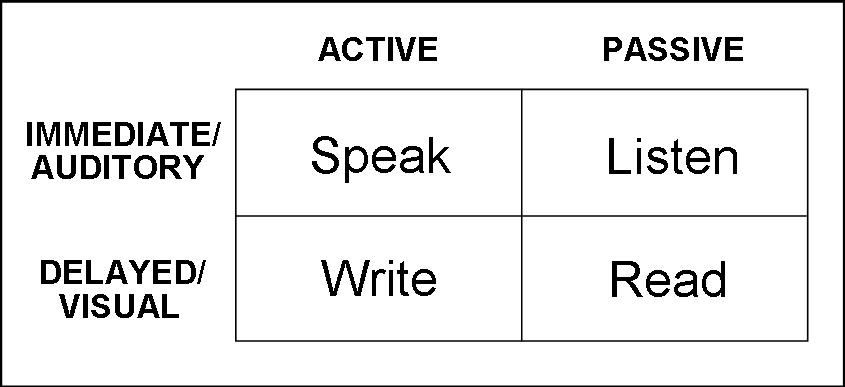
One can define four categories of language ability: the three mentioned above, plus writing. The ease and difficulty of each is a function of the qualities associated with that particular ability, as well as the context in which that ability is required. For example, reading a language is a passive, visual activity, whereas speaking is an active, auditory activity. In general, too, the visual categories (reading and writing) do not have the kind of urgency associated with the auditory categories (speaking and listening), although there are of course exceptions, such as when chatting online. So we can define the following matrix:


One might think that the passive categories would be easier. A person's recognition vocabulary (words he understands) is typically much larger than his active vocabulary (words he would actually use). And how many times have you thought you understood something, only to become confused when trying to explain it to someone else? But there is a tradeoff; when using passive language ability, you do not have control. You could be trying to understand someone who uses street slang and speaks at lightning speed, or trying to read Don Quixote in the original. Active language use is more difficult for the beginner who doesn't have a large enough foundation of vocabulary or grammar, but an advanced speaker can usually make himself understood in some way or another.

Similarly, one might also think that the delayed/visual categories would be easier, since one has the advantage of time. In fact, many people can read and write in a language far better than they can speak it. But the register of language that is used for reading and writing is usually much higher; think not only of great literature, but also of legal documents, formal letters, and the like. Moreover, one is held to higher standards of grammar when dealing with the written word. Again, one can come up with instances of high-register spoken language, such as a philosophical lecture, but the vast majority of spoken language use is for conversation, which uses relatively simple vocabulary and grammar (no 200-word sentences here, even in German!).

So for Spanish, I find that listening is the most difficult, particularly when I'm asked to interpret for people who speak rapidly and with pronunciation and vocabulary that is very different from what's taught in the classroom. Reading is the second most difficult, as I am painfully reminded every time I try to slog through another chapter of Gabriel García Marquez's Cien años de soledad. It's the passive activities that get me, whereas when I'm speaking or writing I can generally get my thought across somehow, even though my grammar suffers when I try to speak quickly.

For my other languages, in which I'm considerably less fluent, the active language use is more difficult; there are many instances where I simply can't come up with a basic word I need, but I can understand what people say to me. This is because I operate in these languages at a much more basic level. Were my German at the level where I was attempting to read Goethe or understand a technical presentation, I'm sure those would be far greater challenges.

It should be obvious from all this that using a single word to qualify one's language ability is woefully inadequate, as much so as describing a person's political leanings as "conservative" or "liberal". With respect to what? In what context? But if you're seeking to improve your facility with a foreign language, thinking about your proficiency in these four categories will help identify your weaknesses. As for myself, I'll continue listening to Spanish radio and interpreting at Rotacare for uninsured Spanish speakers, and I hope the day will come when it will all be easy.

Thursday, January 19, 2006

Music lessons, part 3

There is no direct opposite to the Suzuki method, but teachers commonly refer to Suzuki vs. "traditional" teaching. Since the latter term is vague, for the purposes of this discussion I will coin the term "Smedberg method" after my own violin teacher, whose methods are decidedly far from Suzuki. She breaks down every aspect of violin technique and musicality in terms of cause and effect, with the goal that her students learn precisely how to create the sounds they desire. Because her method of teaching is so analytical, she rarely accepts students under the age of nine, as they can hardly be expected to understand these concepts presented in such detail. It's the analogue of studying language by learning grammar rules and vocabulary lists, which one would never try with a young child. ("What's a past participle, Mommy?")

The "Smedberg method" has been wildly successful for me, no surprise because I am a highly structured thinker with much training in analytical fields such as physics and computer science. For the first time in my life, I feel like I'm beginning to understand the relationships between my hand and arm motions and the sounds that come out of my instrument. It used to be the case that if I couldn't get the result I wanted even after a lot of practice, I'd simply say to myself, "Well, that's yet one more violin technique I'll never get." Now, I've learned to narrow down the problem. Is it my left hand or right hand? Is it pitch or tone that's off? Can I do it correctly if I play it very slowly? No longer is successful violin playing a result of some magic that one has or doesn't have; it's all a matter of techniques that can be analyzed and mastered.

These are the same principles that serve me in my language studies. I learn the rules of verb conjugation, noun declension, adjective agreement, mix in a healthy dose of vocabulary, and I'm on my way to constructing whatever I need. I know when I'm supposed to use the Spanish subjunctive and which German prepositions take the dative case. With a dictionary, I can theoretically use these languages perfectly. And yet, there's a catch...

The danger in relying too much on the Smedberg method of violin instruction, or the classroom method of language learning, lies in that little word: "theoretical". Just about any structured discipline can be analyzed to death, but ultimately these concepts must be put into practice. Although my teacher and I can---and often do!---talk endlessly about planes of motion, centers of gravity, difference tones, and the harmonic series, none of it means anything if I can't translate that knowledge into beautiful violin playing. Because theory appeals to me so much (need I specify that my doctorate was in theoretical physics, and that I'm a danger in the lab?) it's tempting to spend my entire lesson talking about the violin instead of playing it. Similarly, one cannot ever hope to achieve fluency in a language if one is constantly going through the mental process of verb conjugation and vocabulary retrieval; at some point, it has to become automatic.

So the key to language success, I believe, is finding a balance between theory and practice. Too much practice without any theory---generally the plight of people who learn a language through pure immersion---leads to error-riddled fluency and dependence on what "sounds right" without knowledge of why it's right. Too much theory without enough practice---the problem faced by those who study language assiduously in school but never use it outside the classroom---leads to error-free but painfully slow conversation. Start with the aspect that appeals to you most, or is most accessible to you, but do not neglect the other.

Friday, January 06, 2006

Music lessons, part 2

Most people have heard of the Suzuki method, which is based on the principle that people can learn to play a musical instrument in much the same way that they learn a native language. It's hard to dispute the evidence that Suzuki is highly effective in producing talented young musicians. Critics of Suzuki, however, maintain that the method underemphasizes note reading and relies too heavily on passive listening, hampering a musician's ability to sightread and develop his or her own musical style.

I see several parallels between the objections to the Suzuki method and what I view as the inadequacy of learning language in a purely "native" manner, as a young child does. Both forms of learning rely heavily on imitation. Babies hear language spoken by their parents (or less optimally, on TV) and gradually learn to repeat those sounds. Suzuki students listen to their teachers as well as recordings of the Suzuki repertoire and attempt to duplicate the sound. The justification for this is that people must listen before they speak, and speak before they read. But an overemphasis on imitation as a method of learning leads to an underemphasis in developing the speaking (i.e. interpretation) and reading (i.e. comprehending previously unheard material) that are just as essential to music and language mastery.

In college I was in a production of a Gilbert & Sullivan operetta in which the female lead had never had any formal music training and could not read music. Nonetheless, she had a beautiful voice and an amazing ability to memorize both melody and lyrics almost instantly after hearing them. One thing that always bothered me about her performance, however, was that it was stylistically identical to that on the recording by the well-known D'Oyly Carte Opera Company, which was how she'd learned her part. She had reproduced every musical nuance, ornament, even the substitution of certain words in the libretto, and had "learned" the recording so thoroughly that she was unable to follow the director's artistic wishes. And although her singing was lovely to listen to, I found that her lack of versatility made me respect her somewhat less as a musician.

Of the languages I speak, the only one I have learned in this manner is Taiwanese, which I've spoken---almost exclusively with my parents---my entire life. I'm quite aware of a similar fragility in my ability to speak the language. I know what to say by what "sounds right", and what "sounds right" is based entirely on what I've heard most frequently. And though I am nearly fluent when it comes to conversations about food or people (the subjects most commonly discussed in my family), I once went to a political rally and found myself not understanding a word.

I do not mean to imply that I believe these learning methods are useless, simply that they are incomplete. Suzuki is, in fact, probably the only method of music instruction accessible for children under the age of five; I would never allow my daughter to learn with it if I thought the method were inherently bad. But I do feel that the merits of "native language instruction", as touted both in Suzuki and in the multitude of language products marketed to busy professionals, are easily overstated. Mastery requires not only learning by osmosis, but a true understanding of the underlying structure and concepts of the subject. While one may do well to use native language instruction as a starting point, it cannot also be the ending point.

Wednesday, December 28, 2005

Music lessons, part 1

My other passion---besides languages---is classical music. I play the piano and sing on occasion, but I identify myself first and foremost as a violinist. Comparisons between music and language are legion, and with good reason; both are media for works of art which are created on top of some underlying structure. And while certain analogies can be taken too far, there is much to be gleaned from examining the mental processes associated with each, particularly in the way music and language are learned.

Over the last year I've acquired a wonderful violin teacher who is, as I am, extremely analytical in the way she approaches instrumental technique and music in general. By contrast, my young daughter studies Suzuki violin, which is based on the concept that children can learn music the same way they learn a native language. I've observed many parallels between the two ways of learning music and the two ways I've learned language. I'll share some of these observations in the next several posts.

For now, I wanted to relate a short but charming story. One of the signature exercises in Suzuki is playing "Twinkle, Twinkle, Little Star" in various rhythms, one of which is four sixteenth notes followed by two eighth notes. To help children grasp the pattern, teachers frequently use a spoken phrase that follows the rhythm, such as "pepperoni pizza". My daughter's teacher uses "Mississippi Stop Stop", and an acquaintance's daughter was taught "Charlie Brown and Snoopy", all things that are rather familiar to Americans. It's no surprise, therefore, that a fellow on the other side of the Atlantic was taught a phrase significant to his country: "Piccadilly Circus".

Sunday, December 04, 2005

How do YOU learn language best?

There are many ways to learn any subject, and the multitude of language-learning products illustrates this more than perhaps any other industry. One can choose from standard classroom-style courses, audio-only courses, multimedia software, immersion programs...the list goes on. Walk into the language section of any major bookstore and you'll get dizzy from the number of books and tapes claiming to be the quickest, easiest, most fun, or most natural method of learning.

The fact is, learning a language is difficult. Very difficult. It takes patience, dedication, humility, and most of all, time. But you can maximize your chances of success by knowing yourself---how you learn best---as well as having a clear idea of your language goals. One of my life goals is to speak ten languages, five fluently. Obviously I wouldn't have set this goal if I didn't have a natural talent and love for languages, but my job is also easier because over the course of my life I've studied six different languages using various methods and know what works best for me.

I am a very visual person, and learn best in a structured environment. School is the ideal place for my language learning, which is why my six years of junior high and high school German, three years of high school and college Latin, one year of college ancient Greek, and one year of college Spanish have served me well. Unlike many people, I revel in vocabulary lists and detailed grammatical rules. It's not by any means "natural", the way a child learns his first language, but I learn most quickly when I can put a new language into this framework and draw connections to the structures with which I am already familiar.

Taiwanese is the one language which I have learned natively, and it is both more comfortable and less comfortable than the European languages which I have studied formally. More comfortable, because it "feels natural" to me. When I converse in Taiwanese, I'm never aware of any translation process. I frequently don't even realize whether my parents have spoken to me in English or Taiwanese, since the comprehension is so instantaneous in both cases. And yet, my knowledge of the language is fragile. It's not predictive. I have a vague sense of what "sounds right", but given a new word, I wouldn't necessarily be able to use it correctly in all cases until I'd heard it in a certain amount of context. And my vocabulary is seriously limited to the subjects I've discussed with my parents (with whom I do not have a particularly close relationship); I can talk about food and people and actions, but I'm hopeless in a political or technical conversation.

My study of Mandarin has helped me greatly in understanding how I learn, because it's been split between a bit of native learning and the Pimsleur audio course. This has only been moderately successful, because as a visual learner, it's difficult for me to retain something I've only heard. Moreover, neither of these methods explain details that any grammarian wants to know, such as "Why does one say literally 'I am a teacher' but 'I busy'?" (The answer: Chinese has adjectival verbs, not predicate adjectives.) or "When is the particle 'de' unnecessary to show possession?" (Answer: for closely connected nouns, especially two-syllable words for body parts and relatives) I've had much more success now that I have resigned myself to learning the pīnyīn romanization system---which provides a visual representation of vocabulary without the prohibitively slow process of learning characters---and found an excellent book, Barron's Chinese the Easy Way---which anticipates and answers questions like the above. I know what I need to learn language effectively, and although taking classes is not feasible at this time in my life, I can duplicate the elements I find most useful from that environment.

What about immersion classes, particularly study abroad? Constant contact with native speakers is essential, I believe, to achieve fluency. But for someone like me, immersion programs aren't the best solution in the early stages. I prefer to build a basic foundation (by taking classes or studying independently) upon which I can expand once I land in a foreign country, but that's again because I'm motivated, do well in a structured setting, and always seek a deep understanding of my subject. For the reluctant language learner who just wishes to gain conversational ability, this "sink or swim" method might very well be the ticket.

My suggestions for those who embark on the difficult and rewarding task of learning a new language? 1) Figure out precisely what your goals are. Do you want to converse? Read? General topics or specific? 2) Understand how you learn. Are you a visual or auditory learner? Theoretical or practical? 3) Find the method that best suits your style and goals. If you can't use it due to financial or time constraints, don't choose another method; determine what it is that you need and simulate it. If you're a classroom learner like me yet can't take classes, pick a course that presents material in a highly structured and logical fashion. If you're a hands-on learner and can't afford to travel, look for a local cultural community for that language and jump into it. And above all, be patient. No matter what any marketing or advertisement says, learning a language is not quick or easy. It can, however, be fun, and I wish you every success in your goals.

Friday, October 21, 2005

Describing language ability

While updating my curriculum vitae recently, I once again faced my usual dilemma of how to define my proficiencies in the various languages I speak. Words commonly used on CVs and resumés include "fluent", "proficient", "functional", "conversational", and "basic". The last three terms are rather vague to me, though, rather like the buttons on my blender. I'm not really sure if "functional" is better than "conversational", but I use it to mean that I can get around in the foreign country without much trouble, as long as I'm not asked to discuss specialized subjects like politics or science.

The biggest question for me is always whether I can accurately call myself fluent in Spanish, given that I don't have complete mastery of the language. I can express myself in speech and writing pretty well on just about any subject, and read magazines and listen to newscasts without much trouble. But I definitely make my share of grammatical errors, and don't ask me to read Gabriel García Márquez in the original or interpret the rapidly spoken street Spanish in Mexico.

On the other hand, I consider each of my foreign-born coworkers to be fluent in English, and yet their use of the language rarely ventures outside the present indicative. The resumé guides I've read say not to call yourself fluent in a language unless you're willing to conduct the interview in it, which is probably a decent rule of thumb. With that in mind, I ended up listing my abilities as follows:

  • Fluent: English, Spanish
  • Functional: German, Taiwanese
  • Basic: Mandarin

In the end, I probably didn't need to stress out so much over this section. In engineering, the lingua franca is undoubtedly English, and the lack of a huge semiconductor industry presence in Spanish-speaking countries probably renders my proficiency in that language---however one defines it---irrelevant. Nonetheless, I look forward to the day when I can place all my languages in the "fluent" category without any hint of deception.

Monday, July 25, 2005

Marking progress

For me, the greatest joy in studying a widely spoken language is slowly being able to understand more and more of what I hear around me. I had never experienced it until fairly recently, despite my lifelong love of languages, since my first three linguistic endeavors were in German, Latin, and ancient Greek; two of which are no longer spoken at all and one of which is not that commonly heard on the street, especially in the Kansas town where I grew up. But it is a great joy indeed. The comprehension brings satisfaction, of course, but being able to understand native speakers is also immediate proof that what I am studying is real and not just stuff fabricated in a classroom.

During my early Spanish studies, I'd often set my radio to a Spanish station for ear training. At first, the only thing I could comprehend was station identification: "¡Cien punto tres, Radio Romántica!" Then I started getting more and more of the music (love songs involve limited vocabulary in any language, apparently), then the commercials, then finally the rapid chatter of the DJs. In my mind it was like viewing an interlaced GIF, where you get sparse stripes of the picture, bits and pieces which give you a rough idea of what you're seeing, then more details as the image slowly fills in. Four years after I first started tuning to that station, I now understand anywhere from 80-100% of what I hear, depending on how carefully I'm listening. It's a satisfying sign of progress.

I'm still at the loading stage in my Mandarin studies. At work, many of the discussions held between my overwhelmingly Chinese colleagues are conducted in Mandarin, and by combining the fragments I do understand with the English technical terms that are sprinkled in, I can usually get an idea of what people are talking about. The Pimsleur audio course I'm using has been criticized for teaching non-useful Mandarin, that which is spoken only in Beijing and which is overly formal or florid. Until last week, the phrases I'd learned in my course and subsequently overheard at work (e.g. "is it too big?", "tomorrow I'll...") were too short to substantiate or undermine these claims. But one phrase I've learned and like is yī lù shùn fēng, "bon voyage." With a literal translation of "favorable wind," it does sound like one of those poetic things that people never actually say. Imagine my excitement, therefore, when my manager happened to be walking right past my cubicle as she bid farewell to one of our Taiwanese colleagues who'd been visiting for the week. Sure enough, I heard, "Yī lù shùn fēng!" I immediately thought, "Yes! It's real!"

The interlaced GIF continues to load, but I can already tell it's going to be an exciting picture.

Thursday, June 09, 2005

Memorizing vocabulary

If you've ever tried to learn vocabulary by repeating lists of words over and over, you know it's boring and ineffective. Barry Farber, in his wonderful book How to Learn Any Language, recommends something he calls The Harry Lorayne method (named after a magician and memory-training specialist). I was gratified, upon reading about it, to learn that I've been using something similar for years; it basically just involves associating words with images that are meaningful to you. Farber's examples are quite outlandish, involving things like talking grapes and wives with pet moles, but they work; I still remember the Italian word for wife, moglie, from his scenario of a man discovering that his fiancée has an unusual pet and being worried about it until he realizes it's just a "mole, yay!"

Anyway, I don't have the imagination to come up with such things myself, but I have found the image association method to be extremely effective. I tend to associate words with people. Here's a sampling of some mnenomics I've created:

For German:
  • begeistert (enthusiastic): my 11th grade physics teacher, Mr. Geisert, was extremely enthusiastic.
  • der Saal (large room, auditorium): Miss Saal was the star of our high school musical, which was of course performed in an auditorium.

For Mandarin:

  • dāi (stay): My manager is Ms. Dai, and I'm sure she would like me to stay longer at work.
  • shí jiān (time): My brother-in-law's fiancée is a really neat person, and when we visit Florida I always wish I had more time to see Jen.
  • guì (expensive): There's a guy at work named Guey who is always very well-dressed, and I imagine his clothes must be expensive.
  • tóng shì (colleague): This one's easy; I used to have a colleague named Tong.
There's one advantage in having so many Asian colleagues; I've got a large store of names to use for this purpose!

Thursday, May 26, 2005

Pīnyīn hǎo!

In my various on-and-off efforts to learn Mandarin Chinese over the years, I've stoutly refused to spend any time or energy on the pinyin romanization system, even eschewing study materials that use it. My reasoning went something like this:

  • Native Mandarin speakers don't need it.
  • It's nothing but a crutch for English speakers who can't handle learning the characters directly.
  • Once the language is mastered, pinyin is useless; therefore it's an artifical and unnecessary intermediate step.

But after some discussion with my coworkers, about 80% of whom are Taiwanese or Chinese, and reading some web material on the subject (including the excellent Wikipedia article referenced above), I discovered that these assumptions are dead wrong. Wrong, wrong, wrong, to the point where I'm embarrassed at the level of my misunderstanding. Here's why.

Far from being just a tool for Western students of Mandarin, pinyin is actually used in schools in China to teach Mandarin pronunciation to children. After all, it's not as if one can see an unfamiliar character and sound it out as one can with alphabetic languages. The reason I was not aware of this before was that my parents (and I, by extension) learned Mandarin the Taiwanese way, where the Bopomofo phonemic alphabet---which does not use Roman letters at all---is used to represent sounds. So Taiwanese speakers of Mandarin have no exposure to pinyin, and in my life I have associated far more with people from Taiwan than from China.

Furthermore, pinyin is far from useless even once a full vocabulary of Chinese characters is attained. The existence of a standard romanization system eliminates confusion resulting from multiple arbitrary ways of expressing the same sound; the common Chinese surnames Wang and Wong are actually the same, but that's not obvious without a consistent representation. Libraries that carry Chinese language materials use pinyin to alphabetize their books on the shelves. And pinyin is invaluable as a method of expressing Chinese words on a computer, ever more important as we head deeper into the digital age.

I am humbled by my misguided arrogance, and encouraged by the implications of my new knowledge.

Tuesday, May 17, 2005

Back to work

I'm returning to work on-site at my company today for the first time in four months, and have thus rejoined the hordes of techies who fill the highways to converge upon the geographic phenomenon that is Silicon Valley. Now, most people do not consider commuting to be a desirable thing, but for me it is one of the few moments in my day when I have the time and peace to focus on my language studies. My challenge is not to have any English spoken in the car during my 40-minute journey each way, and so I make this drive to the audio accompaniment of the Pimsleur Mandarin II course, various local Spanish radio stations, and the excellent Puerta del Sol audiomagazine.

My experience this morning reminded me that processing another language (which one must do to learn successfully) requires significant concentration and therefore should not be attempted when driving unfamiliar routes. Fortunately for my fellow commuters, I know this one all too well.